An Erhu's Adventure in Canada - An Autobiography.
A brief reflection on learning erhu in Canada, building a cultural orchestra, and sharing music across communities through performances and jazz.
Published • 5 min readA brief reflection on learning erhu in Canada, building a cultural orchestra, and sharing music across communities through performances and jazz.
Published • 5 min readUsing a Gravity heart rate module and an Arduino, I recorded my own ECG while reading Pride and Prejudice, scrolling Instagram reels, and meditating, to see which activity actually calms the nervous system.
Published • 4 min readYour physiological response to consuming short content versus immersive reading.
When was the last time you scrolled some reels? How about the last time you read for leisure?
I found myself enjoying reading a lot more than consuming short-form content, as it brings fulfillment and liberation, while scrolling makes me tired and scatterbrained despite its initial stimulation.
Wondering how my nervous system really responds to the two different activities, I took the opportunity in my BME lab to use a Gravity heart rate monitor module plus an Arduino to collect electrocardiogram (ECG) data on myself.
For some context, ECG is the electrical signal produced by your heart and is one of the most common ways to monitor heart activity and obtain data like heart rate (HR) and heart rate variability (HRV).

Selfie with three electrodes attached to my body, which send ECG data through an Arduino
In this experiment, I conducted three trials:
Each trial lasted five minutes.

Raw ECG signal. Detected peaks are labeled with red indicators.
Here is what raw ECG signal looks like. Each spike represents one heartbeat. Although the raw waveform gives cool Frankenstein vibes (especially when you see the data streaming in real time), what we are really interested in is the heart rate and heart rate variability.
Heart rate reflects how hard your heart is working to pump blood throughout your body. Usually, when we are excited or doing a physically demanding activity, our heart rate increases.
HRV measures small differences in time between each heartbeat. A high HRV indicates activation of the parasympathetic system, also known as the "rest-and-digest" system. Being calm and engaged often increases activity in this system. On the other hand, when we are stressed, our HRV drops, indicating activation of the sympathetic system, or "fight-or-flight" mode. In general, being in this mode for a prolonged period of time is not beneficial to our health.

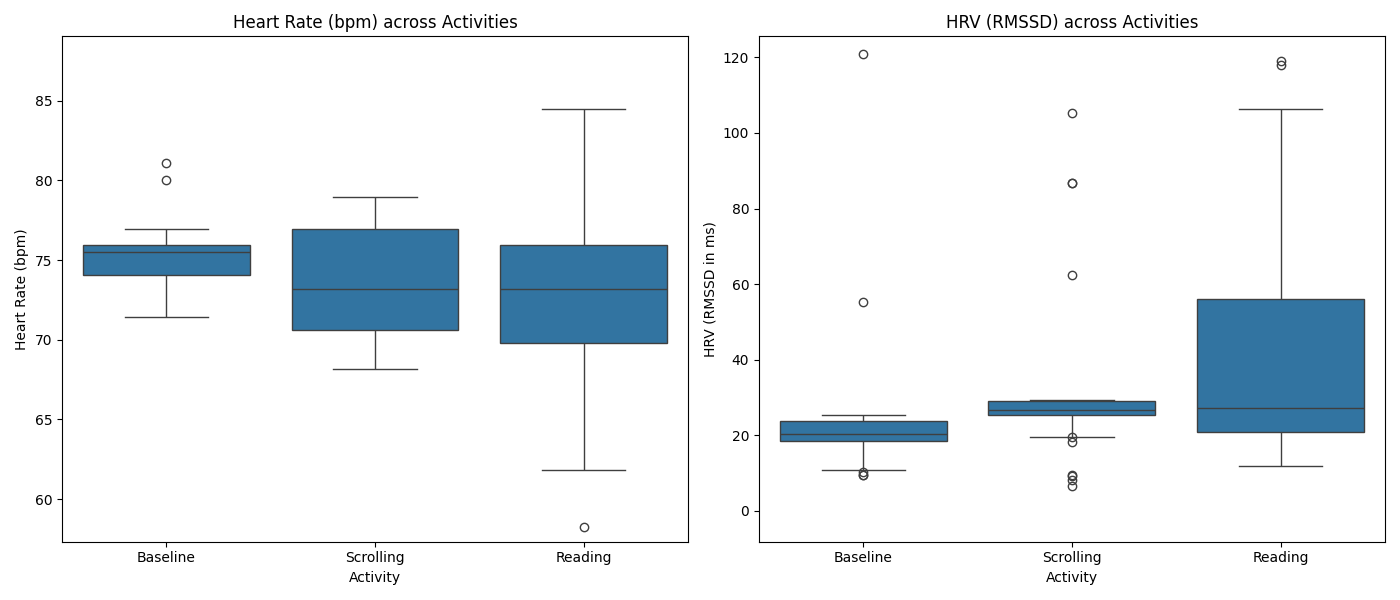
Scaled to fit the box plot, but excludes extreme outliers, displaying heart rate (left) and heart rate variability (right).
The above is a box plot that displays median of HR and HRV and how much they varied during the three trials. I used a box plot because there are many extreme outliers in the data; using median and quartiles is more robust.
Data shows that there is no significant difference between the heart rate across the three trials, suggesting that the activities require similar levels of physical effort, which is reasonable since both involve minimal physical activity.
Turning to the HRV data, we can observe that the median HRV during scrolling and reading is slightly higher than the baseline, though the difference is small, possibly because I conducted the trials consecutively (not good science 😝).
A much more significant insight is that during reading, my HRV spans a much larger range compared to scrolling and the baseline, demonstrating that reading can deliver more diverse experiences than scrolling reels. Reading Pride and Prejudice activates both the sympathetic and parasympathetic nervous systems.
I recall that while reading the book, I sometimes got entertained by the characters' conversations, while at other times I lost focus due to Jane Austen's older language. Perhaps distractions in a lab environment prevented me from fully immersing myself in the plot, or that reading an easier novel would make me more relaxed.
Nonetheless, in this small experiment, scrolling — compared to reading — is more likely to trigger sustained sympathetic response. Instagram reels, though exciting and entertaining at first, may actually make us more stressed rather than relaxed. That may explain why we feel so "brainrot" after doomscrolling.
After learning about how your body responds to reading and scrolling, how would you choose to spend your free time now? I must admit I watched a few reels even while trying to write this, but I will be sure to make up for it by indulging in a few more chapters of Pride and Prejudice before going to bed tonight.
You made it to the end — nice work! I hope you keep it up and continue finding joy in reading for pleasure.